







 Following a dream often involves venturing down a path filled with highs and lows. But even when challenges arise, the potential for success means it’s always a worthwhile endeavor. Such was the case with SigEp’s Florida Nu chapter at Florida International University (FIU).
The university has some housing, but the majority of its 54,000+ students commute to campus. Many live at home and work to help cover the cost of their education, often making living on-campus unrealistic. In addition, at 342 acres, the university has a relatively small footprint, making it difficult to find the space to build new structures. (Comparatively, UC Davis and Texas A&M are both located on over 5,000 acres.)
Past Grand President Tom Jelke, Florida International ’90, who serves as president of the alumni and volunteer corporation (AVC), said other Greek organizations tried to add housing on campus by building out existing spaces, but there wasn’t enough participation from their undergraduates to make it sustainable.
Despite the obstacles, Florida Nu undergrads and volunteers dreamed of having a permanent facility where meetings and events could be held and brothers could spend time together, even if they didn’t live there.
“We’ve been trying to have a home on campus for over 25 years,” Jelke stated. He explained there was a need because course schedules often leave brothers with lengthy periods of free time between classes. Having a dedicated space where they could meet to hang out or study together during that time would greatly benefit brothers socially and academically. At one point, volunteers considered creating a “SigEp dorm” in an existing space on campus and set a fundraising goal of $1 million. That goal expanded to $2.2 million as they began to view new construction as a better choice.
After evaluating their options, the AVC placed a deposit on a piece of land that happened to become available on campus. As volunteers explored multiple options and waited for the right timing, fate intervened. University officials reached out to volunteers with a proposal: Would the AVC be willing to trade their vacant land for a different plot on campus that already had a building on it?
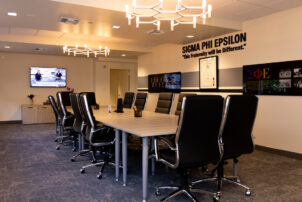 Renovation hadn’t been part of the plan, but as volunteers pondered this idea, a concept for a unique type of facility developed. They talked about creating a SigEp property with study spaces, event and meeting rooms, and a recreational/lounge area where brothers could socialize with each other. This facility wouldn’t be the typical fraternity “house” because there’d be no bedrooms for members to live on campus. Essentially, volunteers were looking to create a learning community facility that wasn’t residential.
As this idea evolved, so did the potential to build a partnership with the university. Why not share some of the space with the university when the chapter wasn’t using it? To Florida Nu volunteers, it made sense, given that the university had limited room to expand. But it took several conversations with FIU officials before they began to envision how the university could use the facility.
As Ben Sardinas, ’01, who served as project manager, observed, “Everyone has the concept in their heads that a fraternity has a fraternity ‘house.’ So part of developing this partnership was helping university leadership understand what we were trying to accomplish now. When the conversation started over 20 years ago, this was [going to be] a residential facility.”
Sardinas noted that another challenge was “to take what had initially been designed as a dormitory with a meeting room, then repurpose it to include an actual classroom.”
It meant renovating an abandoned fraternity house to fit the learning community concept instead of constructing a building from the ground up. Bedrooms were converted into new spaces, including a faculty office and a conference room.
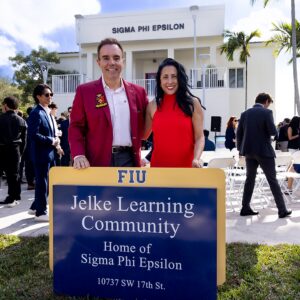
At a ribbon-cutting ceremony on Dec. 6, 2025, the completed Jelke Learning Community was unveiled to the public. Many alumni were involved in making the dream a reality, contributing financially as well as in the concept, design and construction phases. In addition to Sardinas serving as project manager, Florida Nu alumni Juan Linares ’91, served as the architect and Fran Oses, ’93, fashioned the building’s ironworks. The project was also a family affair for Jelke. In addition to serving as a major donor to the project and playing a large role in steering it to completion, his wife, Rebecca, designed the interior.
More than meeting space
The impressive 8,800 sq. ft. facility includes a first floor with three study rooms, a formal conference/meeting room, a pantry and a 2,000-sq.-ft, student lounge where brothers can play pool, video games and cards; watch movies; and gather between classes. These areas will also serve as ideal spaces for brothers to demonstrate Florida Nu’s commitment to and support for academics to potential new members and host recruitment events. The facility includes an office for Florida Nu’s faculty fellow, enabling brothers to receive on-site assistance when they need help with academics. The facility also includes a living space for the resident scholar — a graduate student employed by FIU’s Center for Fraternity and Sorority Engagement — who will be the only person living at the facility. On the second floor, the multipurpose room serves as a classroom from 7 a.m. to 3 p.m. and as event space after 5 p.m.
So far, several academic departments have requested to use the conference room to hold meetings, and the university’s president has expressed interest in using the facility to host a board of directors meeting. One class was held in the multipurpose room during the spring semester as a pilot. Starting this summer, Jelke said there will be a full slate of classes scheduled to use it.
 Beyond what the facility brings to FIU, the Jelke Learning Community has the potential to become a model that chapters on other campuses can emulate. Both Jelke and Sardinas believe that under the right conditions, this type of facility could be a good fit for other chapters. “I’ve had friends ask if this is scalable,” Jelke said. “I do believe it can be done if you have the right alumni, a good partnership with your university and a vision.”
Now that the facility has opened, Jelke said volunteers are focused on establishing an endowment to maintain it. The AVC has reserves set aside for the building’s upkeep for the next few years, but he said they hope to raise up to $1.25 million to manage the facility in perpetuity. “Oftentimes, people build, but don’t plan for the maintenance,” Jelke observed.
Although it took nearly 25 years from concept to completion, Florida Nu’s investment in the Jelke Learning Community has been well worth it for the dividends it will provide: a center for academic support and engagement; opportunities for brothers to connect with each other and contribute to the university; development of a vibrant, welcoming space for recruitment; and a new model for what chapter facilities can be.
Leave a Reply